Blind flanges are solid discs used to close off the end of a pipe, valve, or pressure vessel. They have no center hole (bore), which completely stops the flow. People use them to isolate sections of a piping system for maintenance, testing, or to cap a line for future expansion.
This guide covers the common types, applications, and how to understand their sizes.
Common Uses for Blind Flanges
Blind flanges are versatile. Their main uses include:
- System Isolation and Maintenance: Closing off a section so it can be safely worked on.
- Pressure Testing: Sealing the end of a pipe to test for leaks and strength.
- Future Expansion: Capping a line that may be extended later, which is easier than cutting off a welded cap.
- Permanent Termination: Providing a secure, leak-proof seal at the end of a pipeline.
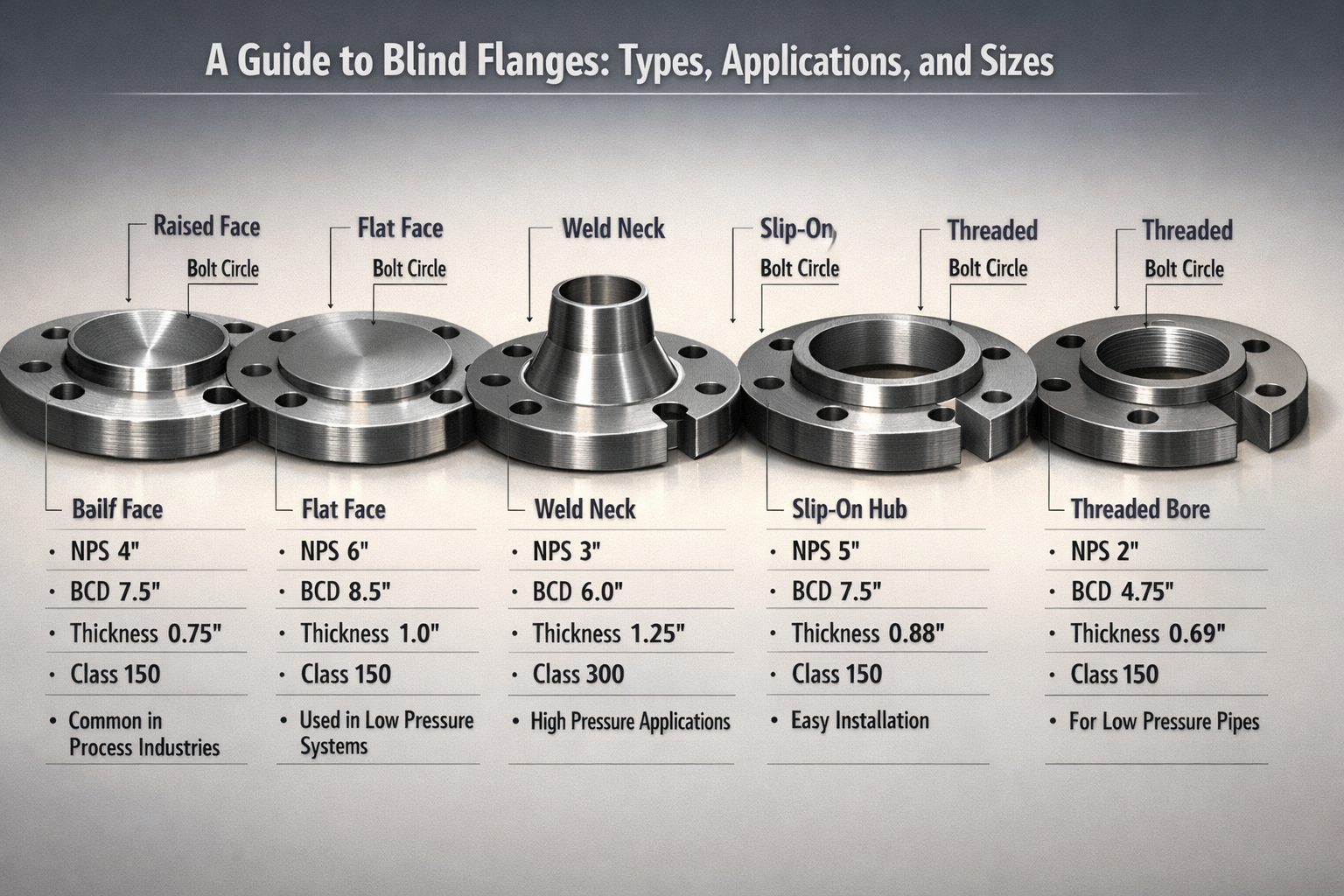
Types and Key Features
While all blind flanges share a basic design, they come with different features for specific jobs.
1. Face Type
The sealing surface must match the connecting flange. The main types are:
- Raised Face (RF): A small, raised ring where the gasket sits. This is the most common type.
- Flat Face (FF): A completely flat surface, often used with cast iron equipment.
- Ring-Type Joint (RTJ): Has a grooved surface for a metal ring gasket. Used for very high-pressure services.
2. Design and Material
- Standard vs. Dished Head: Most are flat, but larger sizes (often 12″ and above) can be “dished.” This shaped design helps withstand higher pressure.
- Custom Machining: Standard blinds are blank discs. Suppliers can machine them with center holes to act as slip-on flanges, or add NPT threads for a threaded connection.
- Common Materials: These include carbon steel (for strength), stainless steel (for corrosion resistance), and alloy steels. The material should generally match the pipe.
Understanding Blind Flange Sizes and Dimensions
Blind flange sizes are defined by two main standards: ASME B16.5 (for NPS ½” to 24″) and ASME B16.47 (for NPS 26″ to 60″). The right size depends on the pipe and system pressure.
Key Dimensions:
- Nominal Pipe Size (NPS): The pipe size the flange fits (e.g., NPS 4″ fits a 4″ pipe).
- Pressure Class: A rating like 150, 300, or 600. A higher class means a thicker, stronger flange for higher pressure. Class 150 is common for lower-pressure systems.
- Outside Diameter (O.D.): The overall width of the flange.
- Thickness: Critical for handling pressure. Blind flanges are typically thicker than other flange types.
- Bolt Circle Diameter (B.C.D.): The diameter of the circle through the bolt holes. This must match the mating flange.
The table below shows how dimensions increase with both pipe size (NPS) and pressure class, using common Class 150 and Class 300 sizes as examples. Dimensions are in millimeters (mm).
| NPS | Class 150 Outside Diameter (mm) | Class 150 Thickness (mm) | Class 300 Outside Diameter (mm) | Class 300 Thickness (mm) |
| 2″ | 152.4 | ~19.0 | 165.1 | ~20.7 |
| 4″ | 228.6 | ~23.8 | 254.0 | ~30.2 |
| 6″ | 279.4 | ~25.4 | 320.0 | ~35.0 |
| 8″ | 342.9 | ~28.6 | 381.0 | ~39.7 |
| 12″ | 482.6 | ~31.8 | 520.7 | ~49.3 |
Important: Always consult the full ASME dimensional tables for bolt hole count, exact diameters, and tolerances. For large-diameter water and wastewater pipelines, separate standards like AWWA C207 apply.
Frequently Asked Questions
Q: How is a blind flange installed?
A: It is not welded. A gasket is placed between the blind flange and the mating flange, and bolts are tightened in a crisscross pattern to create a seal.
Q: Can any blind flange fit any pipe?
A: No. You must match the NPS, pressure class, and bolt hole pattern to the flange you are connecting to. A Class 150 flange will not fit a Class 300 setup.
Q: Why might I choose a dish-head blind flange?
A: For large diameters (often 12″ and up), a flat plate would need to be extremely thick to handle pressure. A dish-head shape provides strength more efficiently, saving weight and material.
Q: Are blind flanges used for testing?
A: Yes. They are ideal for hydrostatic testing, where a section of pipe is sealed and filled with water under high pressure to check for leaks.
Conclusion
Choosing the correct blind flange requires attention to detail. You need to know the pipe size, system pressure, the face type of the mating flange, and the suitable material. Understanding the standard dimensions ensures a safe and leak-proof seal.
Need help selecting the right blind flange for isolation, testing, or system termination? We supply standard and custom blind flanges in all sizes, pressure classes, and materials. Submit your specifications for a quote: http://texasflange.com/lp12/